By clicking “Accept All Cookies”, you agree to the storing of cookies on your device to enhance site navigation, analyze site usage, and assist in our marketing efforts. View our Privacy Policy for more information.



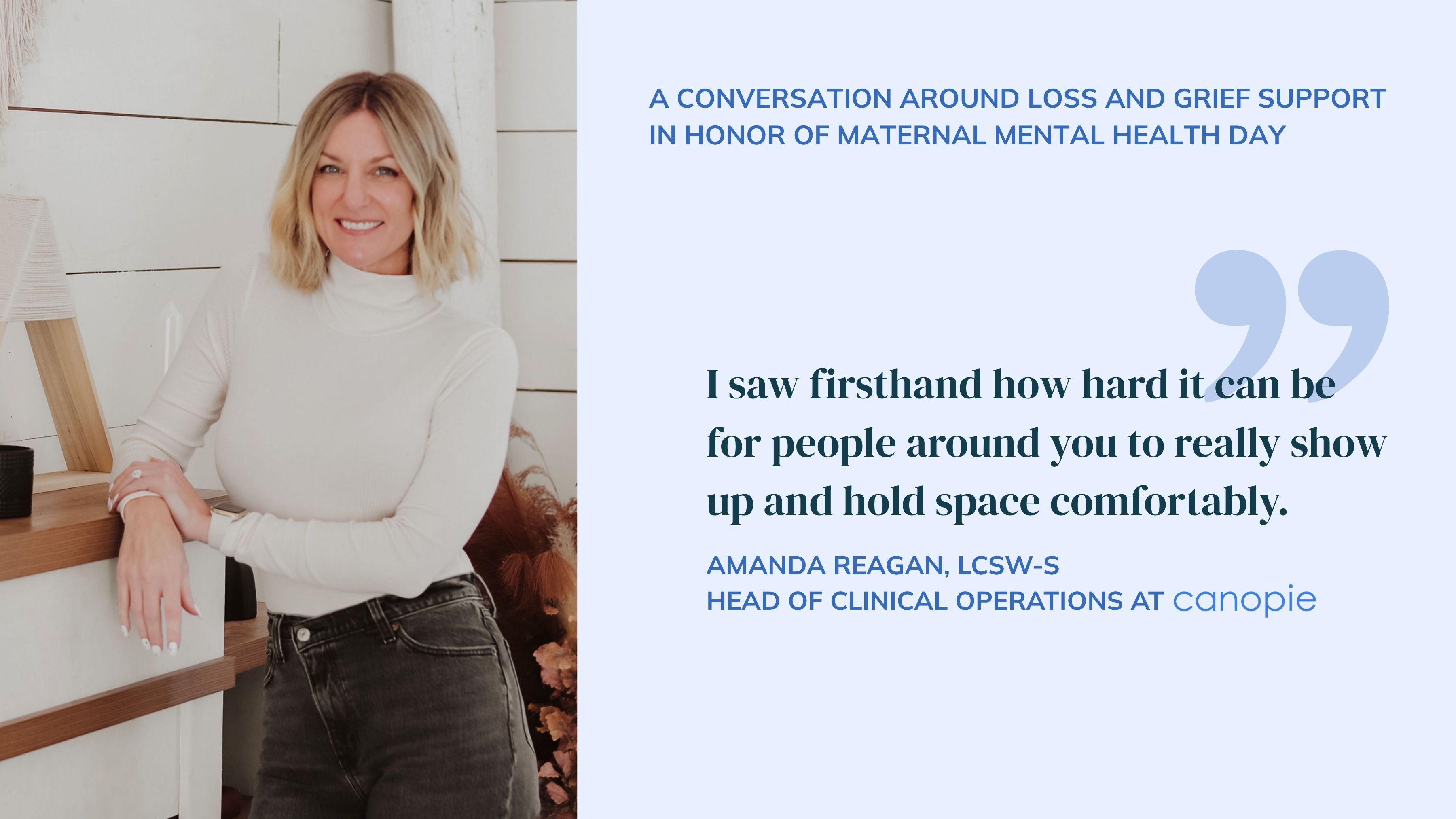
Perinatal grief and loss is one of the least talked about experiences in maternal health. It's common, it's complex, and for many people, it can feel profoundly isolating. At Canopie, we believe that changes when people have access to the right support.
On this Maternal Mental Health Awareness Day, we sat down with Amanda Reagan, our LCSW and Head of Clinical Operations, to talk about her work supporting people through some of the hardest moments of their lives. Amanda came to this specialty both professionally and personally, and her words offer a rare, honest window into what grief during and after pregnancy actually looks like, and what becomes possible when people don't have to face it alone.
What drew you to specializing in perinatal loss and grief?
"I found my way into this work both professionally and personally. As someone with lived experience with perinatal loss, I saw firsthand how hard it can be for people around you to really show up and hold space comfortably. There is something very specific about perinatal loss. It's often invisible, misunderstood and minimized. I saw how few spaces there were where women could actually say the truth about what they were feeling without feeling 'pushed' to move on. That gap really pulled me into this work. It felt important to create a space where grief could exist, sometimes even alongside hope, without forcing either experience."
What have you seen this kind of support make possible for people? What does moving through grief actually look like?
"Support makes it possible to feel less alone in something that can feel incredibly isolating. I've seen women go from questioning their bodies, carrying guilt or feeling disconnected from another pregnancy to slowly rebuilding trust in themselves again. Moving through grief isn't linear. It can feel like you are holding two truths at the same time, like hope and sadness. One moment you may feel connected and the next you are bracing for loss again. The work isn't about getting over something. It is about making space for the grief you are feeling while giving yourself permission to move forward. With the right support, you learn how to tolerate that complexity instead of feeling overwhelmed by it."
What keeps you coming back to this work?
"I can honestly say it is the impact. When women feel supported it changes everything, not just for them but for their families too. Maternal mental health is foundational. It shapes how someone experiences pregnancy, postpartum and motherhood. I also really respect how nuanced this work is. No two experiences are the same, and it requires staying present, curious and humanistic in every interaction. That is what keeps me engaged."
What would you want someone to know, whether they're in the thick of it or just starting to find their footing again?
"You do not have to rush your way out of this. There is no timeline you need to meet and there is no 'right' way to grieve or heal. If you are in the thick of it, it might feel like this will always be heavy. But it won't always feel like it does today. Grief may show up again but that doesn't mean you are going backwards. You can be healing and still hurting. Both can exist at once. But you never have to do it alone."
It takes courage to talk openly about grief, and it takes real skill to hold space for others in the middle of it. We're honored to have her leading our clinical work at Canopie.


%20(1480%20x%20730%20px)%20(640%20x%20845%20px)%20(640%20x%20420%20px).jpg)

.png)
